

Written by Jared T. Hooper on 21 Jan 2026
Distributor KIWIWALKS • Price £16.75
A YouTuber I'm subscribed to in the past has recommended WitchSpring R with his whole heart, but despite his passion and enthusiasm for the game, as well as its apparent mark of quality, judging by the Overwhelmingly Positive Steam reviews, something about it didn't appeal to me personally. So, with some reluctance, I added it to my Wishlist only under the vague notion that I might someday find it appealing, same as many other titles. During a recent Steam sale, I happened to learn of another title in the WitchSpring series, WitchSpring3 Re:Fine, an enhanced port of its original mobile release, and this particular title had a certain je ne sais quoi that did appeal to me, and with it being a cheaper and shorter run than WitchSpring R, I bought WitchSpring 3 as test run for its more popular younger sibling.
Synopsis
Eirudy lives life as a hermit, whiling her days away gathering resources for her hobby of creating dolls and imbuing life into them, with the hope of one day making a doll that can speak, and failing to do so. The story begins with the birth of her latest failure, and after some misadventures with a naughty boar, she has an encounter with a pretty boy named Adrian, or Adri, who quickly becomes her first friend. But befriending him also puts her in the cross heirs of his father, a man who has championed a crusade against Eirudy's kind.
Story
My very first observation of WitchSpring 3's story is that whoever did the English translation was not a native English speaker. It has numerous typos, missing articles, singulars used where plurals should be, and other telltale signs that the translator lacked a full grasp on the English language. I wouldn't say the translation is bad, but upon reflection, I think it gets away from being called horrendous due to its voice acting. Unfortunately, voice options are limited to Korean and Japanese—I played with Japanese voice actors, for reference—but I could still infer the emotions and personalities of the characters from their lines, which made up for the script's shortcomings. I tend to be a stickler for the writing in games, judging a script down to its commas and periods, but for WitchSpring 3, I had to set that critical eye aside in order to adequately immerse myself in the narrative.
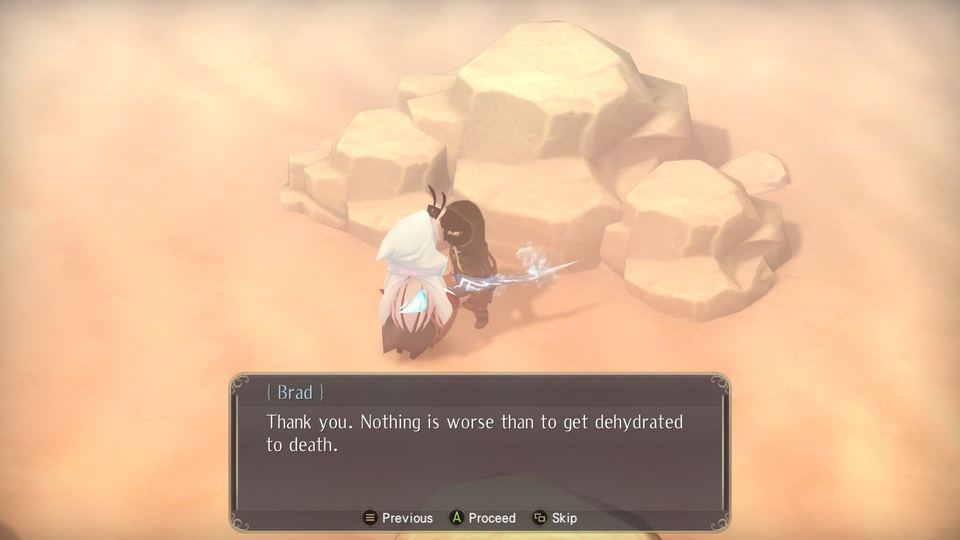
To the script's credit, it is, in most cases, understandable. Instances did pop up when I wasn't quite sure what was being said, but they're rather rare and didn't keep me from understanding scenes or the story on the whole. Curiously enough, when the spelling and grammar is correct, the quality of the translation oscillates between that of an amateur translator who writes awkward or unnatural phrases to “remain faithful to the original script” and that of a professional who'll make minor edits here and there to make for natural-sounding or punched-up dialogue. I was impressively stunned with latter moments when a character used a turn of phrase even an ESL learner of an intermediate level might not know, and what shocked me even more in a good way was how well the comedy played out.
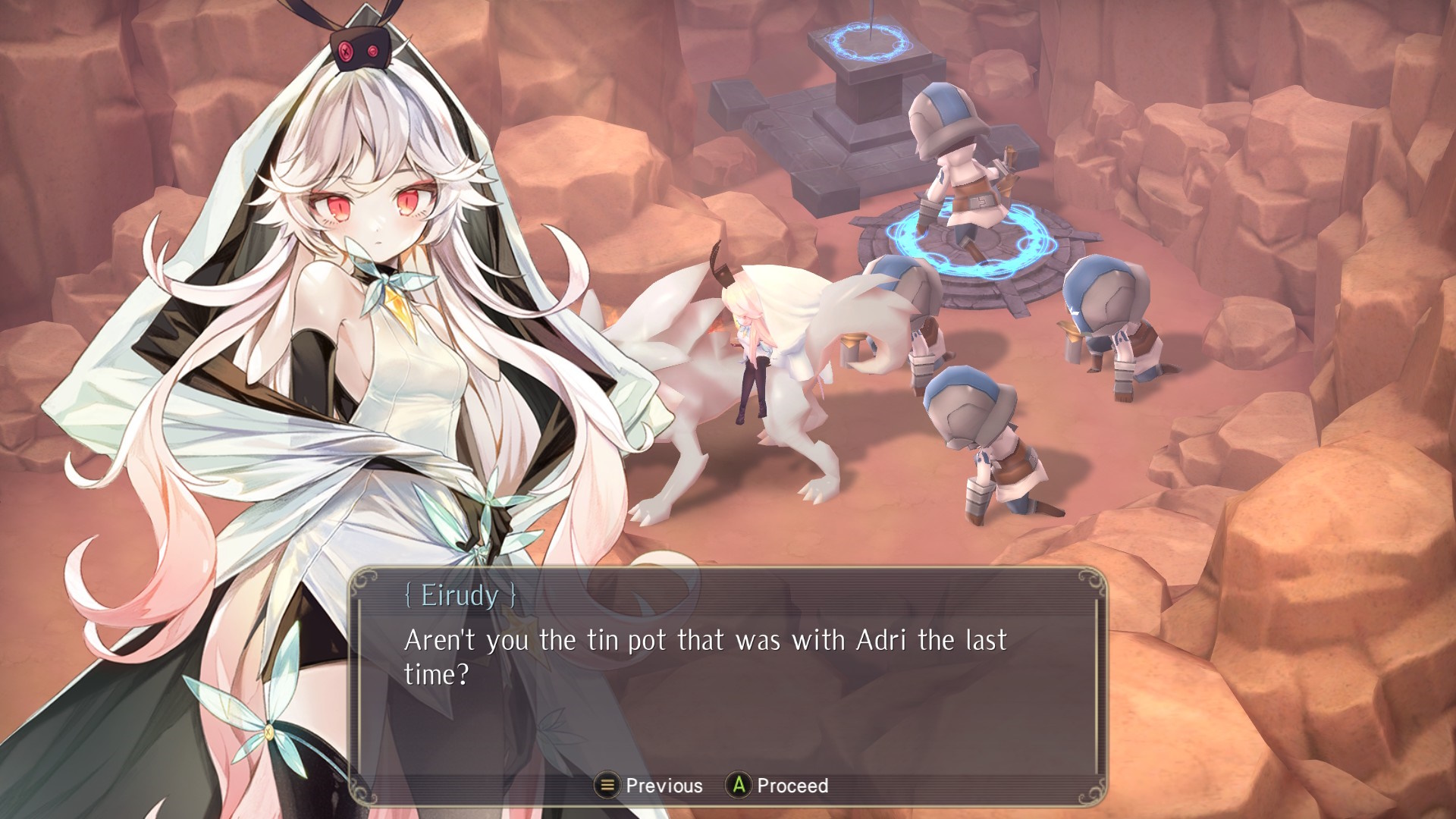
Most of the humor stems from the bluntness or rudeness of Eirudy, who lacks social etiquette, or her misreads on situations. My favorite running gag was her constant assumptions that Adri is a thief since his circumstances just so happen to overlap with a thief's, and she commits to this impression even when seeing the mansion he lives in, thinking to herself, “Wow, he must've stolen a lot of stuff to afford this.” Funnily enough, this specific gag not only livens up Eirudy's interactions with her first human friend, it helps to establish the themes of the story.
The story's main selling point is the branching paths. The tin counts three, but really, it's only two, with the third being Eirudy spending five minutes debating if she wants to be a good girl or a bad girl. It's reminiscent of the late 2000s, when karma systems were all the rage, but while the only reason you might become the Scourge of Humanity in Fallout 3 is because you feel like being a dick, WitchSpring 3 provides cases for both why Eirudy would choose to place her trust in others or wall herself off and strike them down before they can hurt her.
I did both routes, but for my initial and main playthrough, I did the good-girl route, and the story went out of its way to test my commitment to that route. Eirudy is known as a witch, a magical race that's hunted down and executed by the church, and she's survived so far by sequestering herself away in a forest, and revealing her identity as a witch puts her in legitimate danger. Early on in the game, I was given the choice of sharing the location of Eirudy's home to Adri or keeping it secret, and I deliberated for a solid, hard minute what I ought to do. In her own best interests, the wise decision was to keep it secret, especially with the recent reveal that Adri's father is the spearhead in the genocide against the continent's witch's. Even though Adri had been nothing but kind and sweet toward Eirudy, there was still that risk that he could turn on her—emphasized by the gag, whose understatement is that we don't truly know Adri as a person—or the information could be tortured out of him. Eventually, I decided to share the location of Eirudy's home, mostly because I was going for the good-girl route and that was a very good-girl-route thing to do, and partly also because I had recently seen video essays on Studio Ghibli films that discuss how their protagonists earn the trust, friendship, or companionship of others, particularly disagreeable folks or even straight-up antagonists, through kindness or understanding, and I wanted to practice that in WitchSpring 3. Even after the fact, stocking my trust in Adri seemed like a risky investment, since others around him, who previously were allied with Eirudy, or at the very least neutral, would turn on her. The story isn't flush with these choices, but it does put Eirudy through just enough of the volatile nature of humans that these few choices felt consequential.
After beating the good-girl route, I went for the bad-girl route. Unfortunately, there's no New Game+, so I had to start from scratch. Not the hugest deal, since the story's not that long, though I spent more time playing catch-up than I did seeing the new material, but that new material really gutted me. Eirudy turns into a walking murder machine, going out of her way to slay soldiers so she can power up off their souls. But she doesn't do this just because she's angry and distrustful. She does this to free Adri, who was imprisoned not long before, and it was heartbreaking seeing Eirudy cut down former allies and genuinely good people in order to save a man who would hate what she had become.
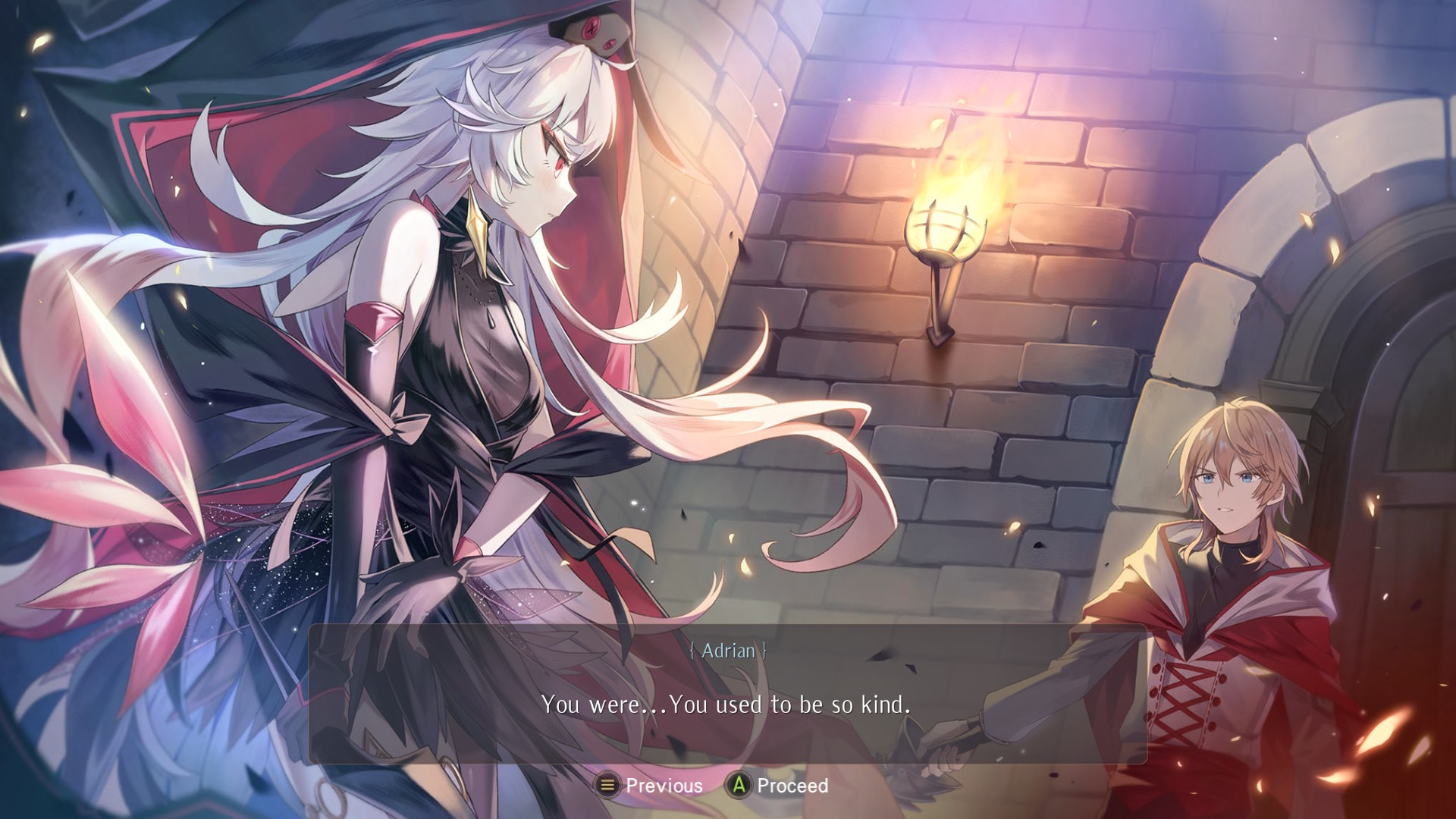
Of the two routes, I liked the good-girl route more, since that's the meatier one with the happy ending, but it was the bad-girl route that hit me harder in the feels. After completing the bad-girl route, my next morning was spent mulling over the monster I had made out of the formerly sweet, kind Eirudy. The good-girl route, though it did try in its own way, didn't touch me the same. However, I think it could've had the story, rather than branching into separate paths, been a single linear narrative.
Imagine that Eirudy takes the bad-girl route first, murdering countless soldiers, betraying old allies, striking terror into the hearts of innocents. At some point, things break, and—this is adding an element not present to the canon story—time shenanigans send Eirudy back some days or weeks to make the choices that put her on the good-girl route. Then there would be a reconciliation with her allies and healing of her soul as she puts an end to the witch hunts and earns her happily ever after.
This layout wouldn't need to do away with the choices, either. Ones like whether to reveal the location of Eirudy's home or not can stay, though the pivotal choice that decides her route would be washed away as Eirudy herself makes that call, and then for the redo, that choice returns, now with the option that leads to the good-girl route, and the true ending.
Granted, this approach is rather ambitious for what was originally a mobile title. But WitchSpring 3 has the skeletal structure of a good story, and this is an example of how it could've been worked into something great or perhaps even outstanding.
There're a few more bullet points on the story I want to cover, but I don't have a way of segueing smoothly into them, so I'm just going to shoot them off in no particular order.
As is a common problem in JRPGs, the story and combat don't always align. Most commonly, how the characters react to the battle versus my performance. In one battle, I defeated a giant armored dude before he could get an attack off, and after the fact, Eirudy commented on how much stronger he was than in a prior battle. A similar thing happens later on when Eirudy teams up two other witches, one of whom can cast a powerful spell to one-shot a dragon but that requires a charge-up. However, I had overleveled myself to where I defeated the dragon with two backhands, before that witch could get her spell off, yet after the battle, the hot topic was how insanely gnarly that spell was. You know, the one that was never cast, that I never saw. I get it can be tricky to accurately tune dialogue to suit a player's performance in combat, but in that latter case, it's a simple binary. If the spell is cast, trigger dialogue where the characters glaze up that witch, and if the spell isn't cast, Eirudy instead is praised for felling the dragon without that spell.
Something I didn't notice until I started a new save for the bad-girl route is how Eirudy's voice changes throughout the story. Eirudy doesn't emote much, speaking almost exclusively in a monotone, which doesn't change save for several key scenes, or that's what I thought. Upon restarting and hearing how emotionless Eirudy's voice was, I realized that her tone had changed during the course of the story, growing tinged with more feelings and emotions. It's a very subtle shift, like Arrisa from AI Limit, but the shift is there.
These last two paragraphs are going to be end-game spoilers.
The story begins with Eirudy trying to create a doll that can talk, presumably so she has a friend to talk to. The story does give Eirudy what she wants, as by the end of the good-girl route, she has plenty of people to call her friends, but her goal of creating a talking doll isn't ever expanded upon, even though it easily could've been. Anytime the player awakens a new doll, Eirudy could grumble about how it doesn't talk, and if she awakens a new one once she's got plenty of allies by her side, her language changes to something softer, that she doesn't mind that the doll can't talk. The epilogue could've hammered in this growth for Eirudy with a scene where she's in the basement of her house, examining the dolls, when Adri comes down and tells her that everybody's waiting at his mansion for her. She then happily goes with him, leaving the dolls behind.
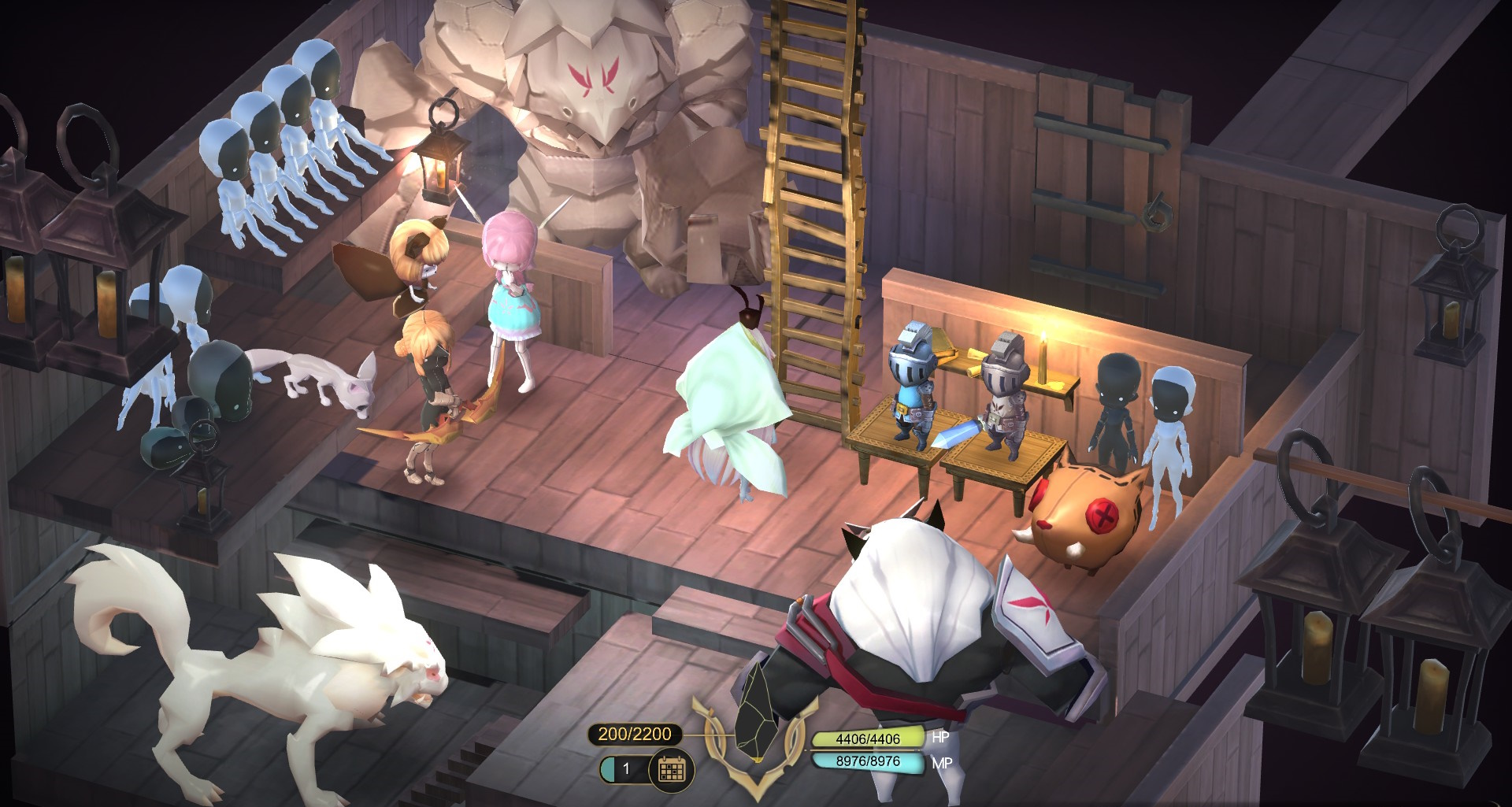
After defeating the final boss of the good-girl route, Adri's father, as he lay dying, undergoes the same last-minute heel-face turn as Zephia from Fire Emblem: Engage, in how it turns out he actually wasn't that bad after all and just wanted the best for his family. Could've fooled me with his actions throughout the literal rest of the story. Although the themes of WitchSpring 3 encourage not assuming the worst in others or giving them your best, telling us that Adri's father was just a family man who was tricked into doing bad things was phoning it in, and I don't see what was wrong with keeping him evil. He devoted his life to capturing and slaying witches, invited Eirudy to his home with the express purpose of trapping her, used his own son as bait to lure her out of hiding, talked a big game about how the only thing that matters is power, and when his wife is revived from a years-long comatose state, he barely lifted a brow. If I had a wife who woke up from a coma, I'd spend the next two weeks parading her around town. The story does nothing to earn this last-second sympathy for Adri's father, and I would've been more content had he just rolled over and died without another word. His final moments of reveal and regret could've been earned had we gotten some backstory about how he used to be a bright-eyed and optimistic young man but came under the influence of power over time or after a specific tragic event, so then the final battle then could've been about putting down a fallen hero instead of throwing a last-second pity party.
Gameplay
WitchSpring 3 has the usual mechanical suspects from other RPGs—level ups, enemy drops, etc.—but goes about them in ways I quite took a liking to. Eirudy lacks levels in the official capacity but does have them in the form of training sessions, which are gained not just from battle, but by forging materials or crafting goods, and whenever the mood strikes, you can splurge these training sessions to boost the stats of your preference, like a beefed-up version of what Ara Fell or the Paper Mario games do. This system saved me from agonizing over which stat to prioritize with a paltry +1, allowing me to instead give everything the loving it needed, resulting in a nice look at my bigger numbers.
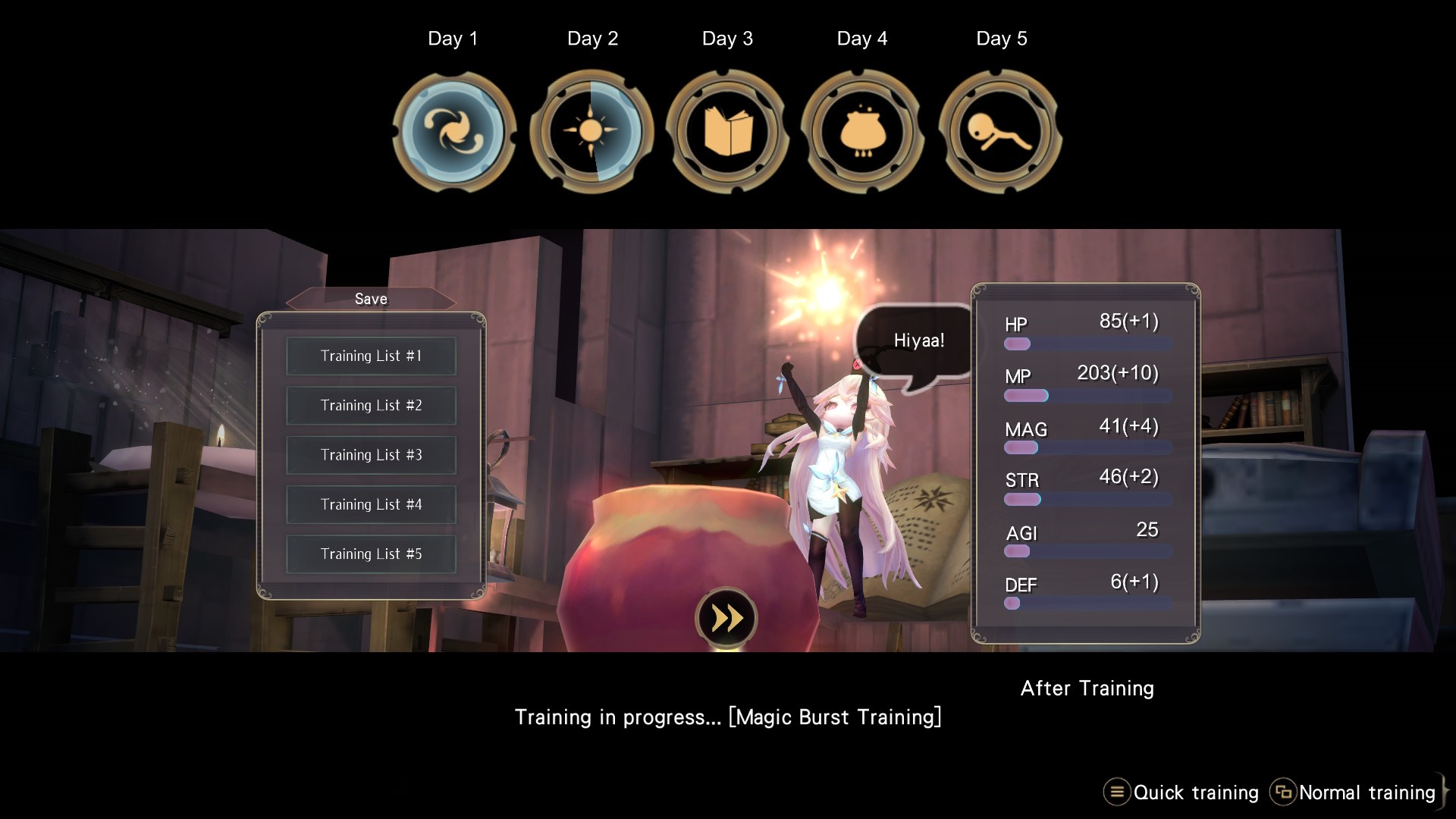
But beating up monsters for the sake of bigger numbers is pretty dull, which is why I always beat them up for their spoils. Like Atelier, crafting is the name of the game. Grasses are plucked, monster pelts are skinned, and it's all dropped into a cauldron to fashion a shiny new sword or magical spell or spiky stone that'll buff Eirudy up. And sometimes, I used those swords or stones to fashion even shinier swords and even buffier stones, then I'd head back into the field for more ingredients while also using those same monsters as guinea pigs for my new gear. It's a feedback loop like the systems augmenting Xenoblade 2's combat, just trimmed of its excess and more transparent. On more than one night did I say to myself, “Okay, I'll get this material to craft this tool, then it's off to bed,” only to realize I'm short an ingredient for something else, so I pick that up, and I see that a miniboss just respawned, so I nick its drop as well, and now I've got plenty of training sessions stacks up, so I'll pad up my stats, and now I've unlocked a new attack, so I wanna test out my new-and-improved combat prowess, so I bully a boss, which gives me a material to craft something else, so I get that made, and the next time I look at the clock, it's been two hours. Much like with Persona 5 and my habit of going, “Just one more day, just one more day,” it's all these little things in WitchSpring 3 that suckered me into playing like I was one spin from hitting the jackpot.
Since materials need to be continuously ripped from baddies' cadavers, crafting does get a bit grindy, but I didn't find it too bad because of enemy drop rates: they're 100%. So no beating up the same herd of buffalo twenty-two times to get that horn with a 5% drop chance because in WitchSpring 3, you just need to fight that buffalo once and it's yours. For the most part. (Get used to that phrase.) I can count exactly two enemies that will drop more than one type of item, and that second item was never what I needed. It befuddles me why every other enemy follows the one-drop rule but these two specific enemies don't, and the one has a material used in several crafting recipes, lengthening my grinding time, lengthened even further by the respawn timers that stalled me until enough time had passed for the enemy to come back to life. It's a nasty smudge on an otherwise perfect system.
Another system that's almost perfect is how you enter battles. Baddies loiter around on the map, and once you enter their attack radius, a menu pops up with their stats and the options to either fight them or run away. I love this so much because it lets me know what I'm getting into before I get into it. There's no challenging a baddie only to find out it has the stats of God, for the most part. The one blemish in this system are the handful of instances where you might be exploring only for a dragon with the stats of God to swoop in for a fight you can't run from.
Combat's all about combining Eirudy's arsenal of tools. She can physically attack a baddie multiple times, but those attacks will deal more damage if she had cast a spell the prior turn, and then she can bump up her damage even more by coating her sword in magic. It's a juggling act I would say keeps battles from getting stale, but the strategy I just described is the only strategy in the game. Cast spell, put explosive magic on sword, swing sword seven times, repeat: that's how nearly every battle went. Despite that, I never got bored of combat because after an intense crafting session, I was on the lookout for how powerful my attacks now were. I will admit that I used to scoff at people who got hooked on games like Cookie Clicker, whose sole appeal is making number big and big number bigger, but it turns out I'm just as susceptible to big numbers if you plant them in a JRPG.
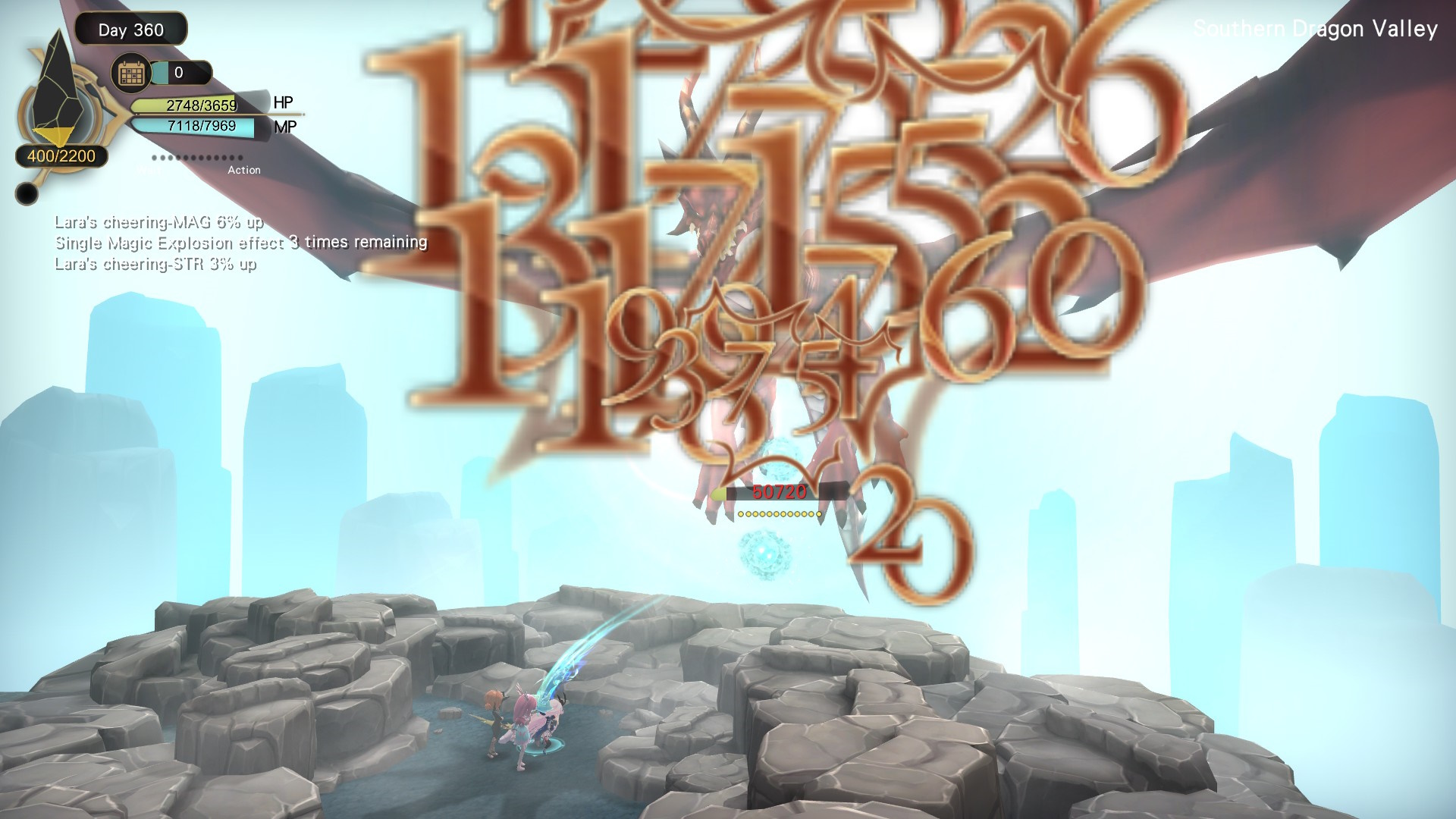
Eirudy can also defend, which doubles as a method for restoring HP and MP, but I only found it necessary in the superboss fights. The one thing spicing up the commonplace battle was Eirudy's dolls, which serve as both her summons and her party members. Each has a specialized task, and for the most part, they're useful to some capacity or another the whole game. The only standard doll I found lackluster was this little soldier dude who would tag-team baddies with me, but he only joins in if I do basic sword strikes, sans magic, and since the damage output of my magic-coated sword was greater than our double-team, I never bothered with him. Eirudy also gets “all-powerful” dolls depending on her karmic path, but these dolls, as far as my investigations took me, can't be leveled up, so their damage output was pitiful beside me and the standing army I had spent 80% of the game muscling up.
In addition to swords, Eirudy can use staves, which utilize magic over strength, but you have to go out of your way to obtain them, and sword strikes did so much more damage than magic spells that I never saw the use in specializing in staves. In general, I found magic wanting, specifically and especially the support magic. At the start of the game, each spell can be equipped with a rune that boosts its power or decreases its MP cost. “This is great!” I got to thinking. “With this system, I can maybe double-cast a spell or give it an additional status effect. There are so many possibilities!” What a sweet summer child I was. Those two support runes I described are it and everything. The only other ones in Eirudy's grimoire are better versions. It's a personal pet peeve of mine in RPGs to ditch obsolete equipment for newer, shinier, sexier models, but while this practice can be justified because old equipment can be sold for coin, you can't sell a spell, so by the end of the game, I was loaded up with spells I had no reason to ever use again. Old materials can be used to make better materials. I don't see why the same can't be done for spells, even offensive spells, since each rank is just a stronger version of what came before.
As much fun as I had breaking the combat system, I can't deny that if story were a few hours longer, I would've grown bored and fatigued. The depth of WitchSpring 3's combat is about on par with Evernights's, where there's just enough depth that kept me engaged and the story is just short enough that the combat doesn't overstay its welcome.
Jank
As stuck in to the gameplay loop as I got, this game is rather buggy. The very first time I booted up the game, it refused to acknowledge my controller. Settings aren't available from the title screen, and once you can get to the settings menu in-game, there's no tab for managing controls, so that had me thinking there was no controller support, period, despite what the Steam page claimed. It does have controller support. For whatever reason, getting the game to recognize my controller was a matter of doing the Steam equivalent of banging on an old TV set to get a signal.
Once I could move via my preferred method, things were still off with Eirudy's movements. In every other game ever, when you let off the thumbstick, your character will stop moving altogether, but Eirudy will jog in place another two steps. I wouldn't call this a glitch so much as a holdover from the mobile version, in which I assume the player controls Eirudy by tapping the screen and she'll pathfind to that spot. It was a bit strange having this decay in my momentum, but an adjustment period wasn't necessary, and I spent the rest of the game controlling Eirudy the same as any other game. Except when it came to stairs.
Forget the NPCs that betrayed Eirudy. Forget that a-hole villain and his eleventh-hour woe-is-me speech. Forget that post-game superboss whose stats scale to Eirudy's, so you can't just grind to his level. My one and true nemesis in WitchSpring 3 is stairs. Whenever I came to a set, there was a tail's chance in a coin toss walking Eirudy up them was like handling my controller with my feet. I tested this using a mouse, and she navigated up and down flights and around bends without the slightest hitch or hiccup. Obviously, this is the intended input.
While WitchSpring 3 can be played and enjoyed without its bugs interrupting the experience, the cumbersome navigation on stairs with a controller is the start of a list that makes me suspect this game was taken out of the oven a minute or two too early.
This list begins with items as benign as visible map edges. In specific spots, you can see the edge of the map, which is usually stretched beyond the camera's reach or hidden behind props. In one cave, the map edge pokes out because a rock that should've been placed to hide it never was. And when entering a desert town from the north, the map just ends, with a ton of void visible beyond, something that's not the norm when not inside a building.
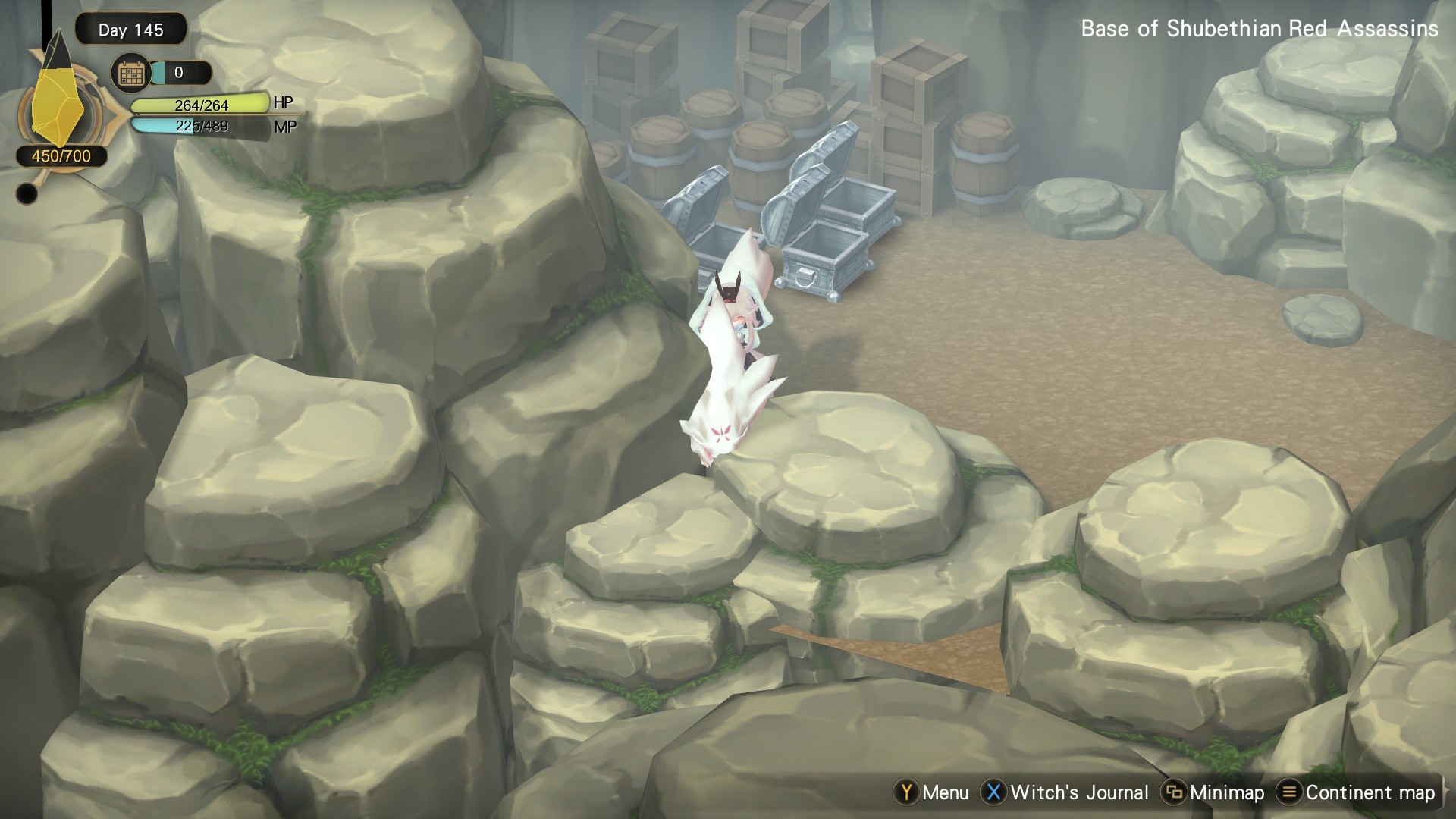
There's also a glitch where sometimes after closing the menu, my movement controls were disabled, so I would have to reopen and reclose the menu to reenable my movement.
One of the areas on the good-girl route is a floating temple. For story reasons, you have to talk to a pair of witches, but there's this partially hidden chamber where you can get a new spell or two, so I went there first. When I entered, one of the witches popped in, told me how exactly to get the spells, then dipped. Later, I went and spoke to that same witch, and she said, “Oh, Eirudy, I didn't know you were here.” Evidently, I got the spells sooner than intended.
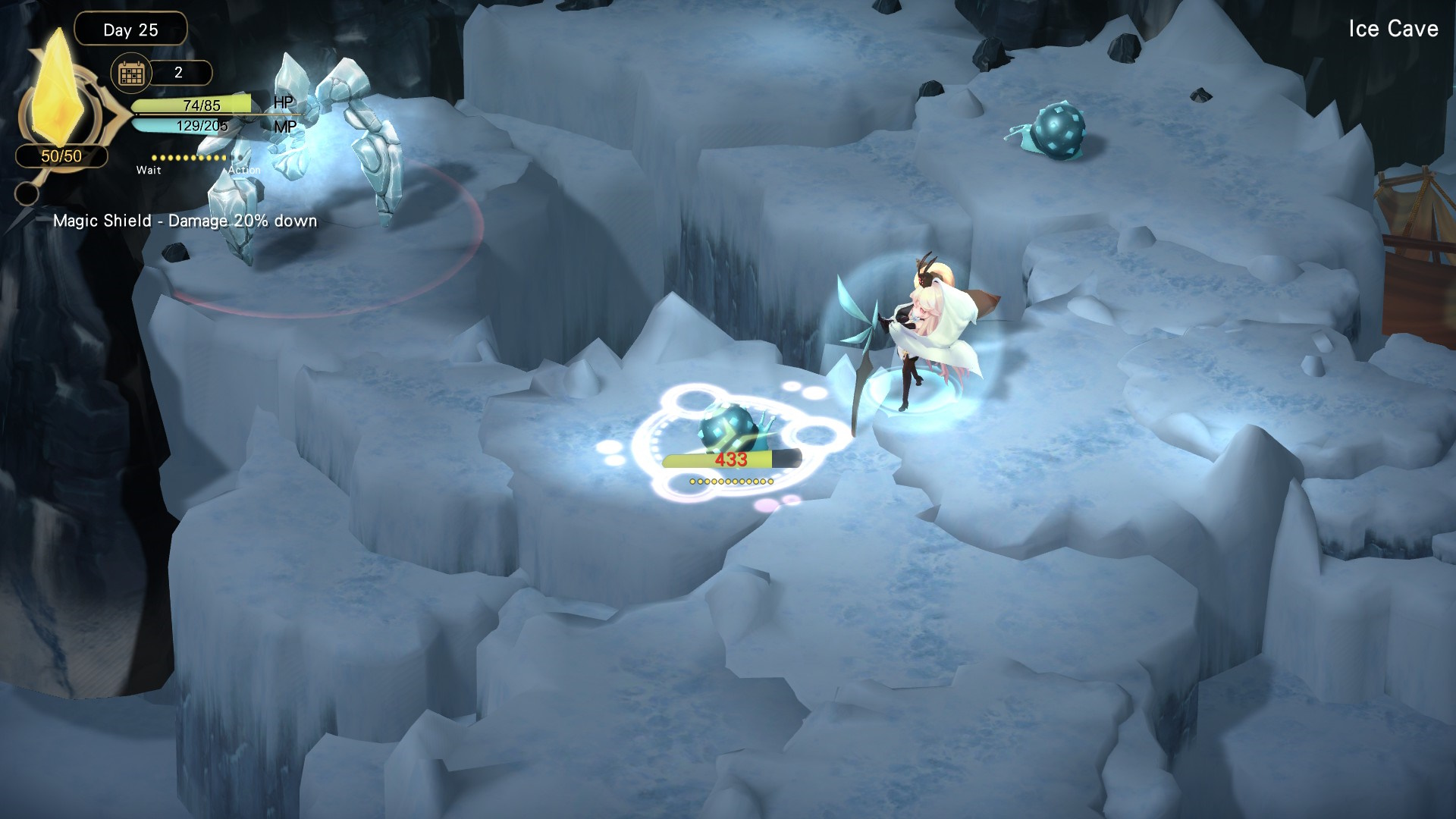
Watch anything on Boundary Break and you'll learn about the various tricks developers use to put on the theater that is their video game. The animators at Monolithsoft, for example, in the first Xenoblade Chronicles often put their characters in strange poses to capture the cinematography they wanted. While WitchSpring 3 no doubt does this aplenty, there are moments when the curtain to hide the stagehands wasn't drawn. One time, I was exploring the dark depths of an icy cavern when a platoon of ghosts floated in from the dark, requested that I defeat an evil spirit, then returned to the dark. At this point, I believe the developers intended for me to turn around and look for this evil spirit to fight, but I instead followed after the ghosts, came to the edge of the walkable path, and found the undead platoon hanging around, doing nothing, saying nothing. I'm 93% confident the intention was for them to be out of frame, where I couldn't see them, but for whatever reason, they weren't tweened that far.
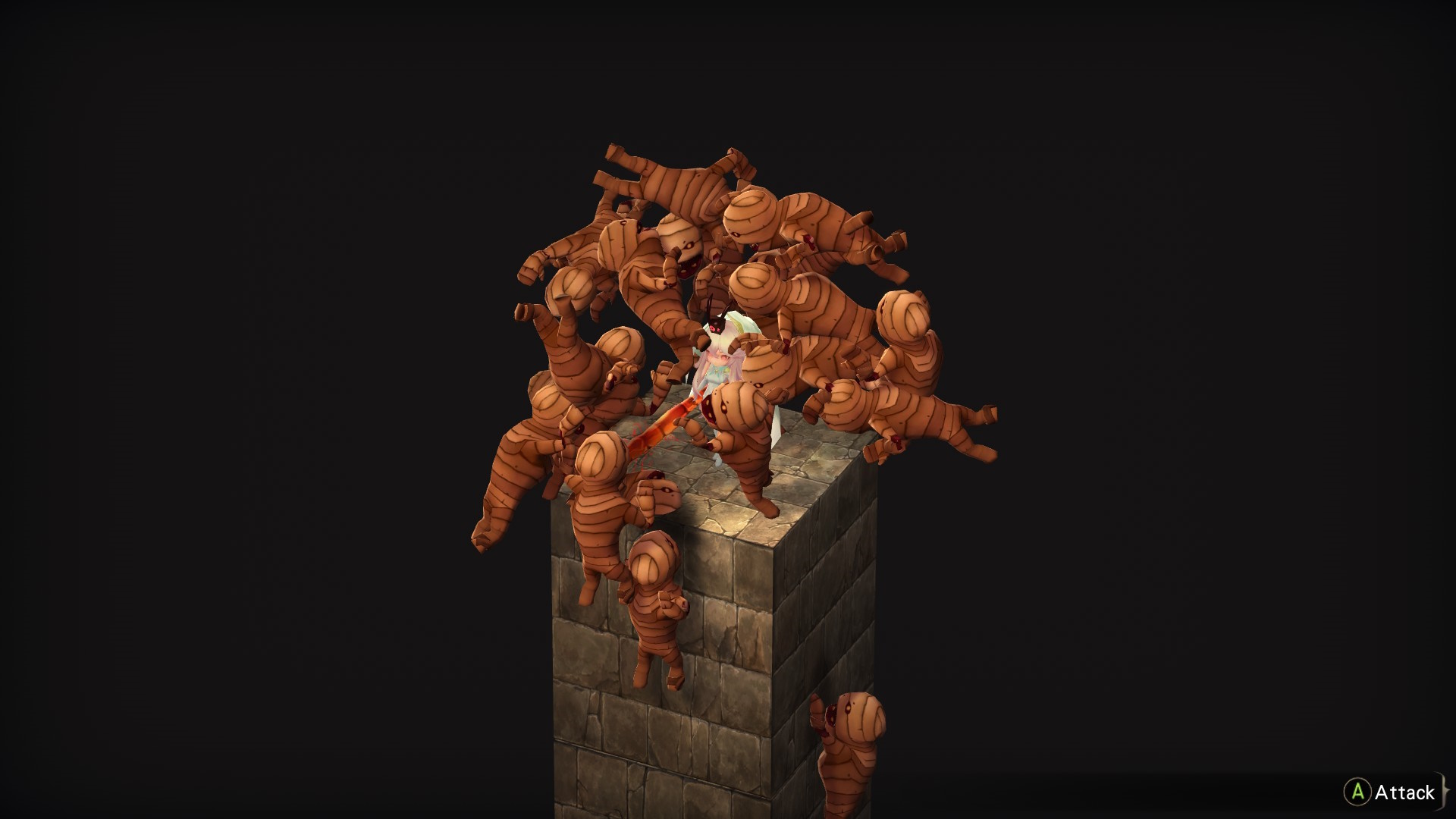
Another moment isn't the curtain being undrawn, but the actors doing a highly unsynchronized dance for a stageplay that's supposed to be dramatic. On Eirudy's good-girl route, she has to undergo this trial in which she stands atop a pillar as hoards of Gibdos clamor up. I swatted them off, but after a minute of nothing happening, I hypothesized this was like Cecil's job change to a paladin, so I put my controller down and let the Gibdos come get me. The story progressed, though I wasn't sure this was the right call, as the Gibdos would collect around Eirudy to the point where she was the Tootsie Pop center of a giant lollipop made of Gibdos breakdancing midair. It was such a messy display that I couldn't confirm that was the intended scene until I saw the same thing in someone's Let's Play.
I imagine there's a handful of other glitches and such jank I'm forgetting about, but my broad point is that as you play, you'll trip over bugs rather often and come across moments and setups that weren't thoroughly tested or plotted to account for how they would look or diversions players might take. None of it'll ruin, break, or softlock the game, but it does make WitchSpring 3 seem, to continue my earlier idiom, slightly underbaked.
Conclusion
Even though I picked up WitchSpring3 Re:Fine to gauge my interest in its more popular contemporary, WitchSpring R, I came away absolutely enamored with this game. Even despite its shoddy English script, even despite its lack of polish, even despite its penchant for just missing perfection, I loved this game. It's much like Xenoblade Chronicles 2, which is rife with faults and flaws, yet despite those, I love it for what it is at its core. And with the developer KIWIWALKS recently teasing an image of their next title's upcoming protagonist, who bears a striking resemblance to Eirudy, I'm more than excited to not just jump into WitchSpring R, but for what the series has in store for the future.


Just writing about the video games that tickle my fancy when the fancy strikes.
posted by Majkol Robuschi on 25 Feb 2026

posted by Ross Locksley on 23 Feb 2026

posted by Ross Locksley on 20 Feb 2026

posted by Eoghan O'Connell on 19 Feb 2026

posted by Jared T. Hooper on 17 Feb 2026

posted by Ross Locksley on 11 Feb 2026

posted by Jared T. Hooper on 06 Feb 2026

posted by Eoghan O'Connell on 04 Feb 2026