
Written by Eoghan O'Connell on 04 Feb 2026
Distributor Square Enix • Price £44.99
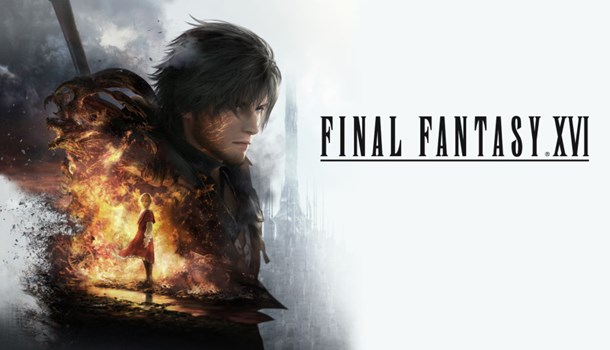
The very first video game that I remember having a significant impact on me was the PS1 release of Final Fantasy IV, part of the Final Fantasy Anthology. Later on, Final Fantasy IX ended up becoming my favourite game of all time and, by that point, I was hooked on the franchise. However, I’ll admit that my enthusiasm for the series has waned over the years due to a mix of Square Enix’s bizarre business decisions and a suboptimal game in the form of Final Fantasy XV. When I was younger, I would always buy a new mainline Final Fantasy game day 1 but, in the case of Final Fantasy XVI, I held off, waiting for a discount before I tried experiencing it. That discount came in the form of what I can only assume was an error on Humble Bundle where I snagged it for what seemed like an unusually low sales price and then, next day, saw that its sales price went up to match that of other storefronts. I decided, as a fan of Final Fantasy, that I would not only give this game a try but also write up my thoughts on it. So, with that being said, what is the sixteenth entry in the long-running venerable franchise about?
Clive Rosfield is the son and firstborn of the Duke of Rosaria but serves as the shield of his younger brother, Joshua, who is a Dominant. These are hosts for powerful, god-like beings called Eikons and Joshua serves as the Dominant for the Eikon Phoenix. However, a blight is ravaging the land, driving the various states to war with one another for resources. Concerned with the oncoming conflict, the Duke brings Joshua, accompanied later by Clive, to perform a rite which will help Rosaria against the Iron Kingdom. However, things do not go as smoothly as planned. The rest of the story takes place thirteen years later with Clive a changed man.
As far as Final Fantasy stories go, I would say that Final Fantasy XVI’s is rather middling. It toys with interesting concepts such as discrimination and environmentalism but I think these concepts were better explored in prior games, Final Fantasy X and VII respectively for those themes. I do like the use of timeskips as they allow the main cast members to shift in personality and role although they bring their own issues as well. It doesn’t help that the world of Final Fantasy XVI, Valisthea, is one of the more uninteresting and bland ones crafted for the franchise. While the use of crystals and the existence of Eikons lend the world some flavour, it often comes off as feeling like generic medieval fantasy. One pleasant surprise though was the existence of moogles. I honestly didn’t expect XVI to include a living moogle given its tone so that was a pleasant surprise.
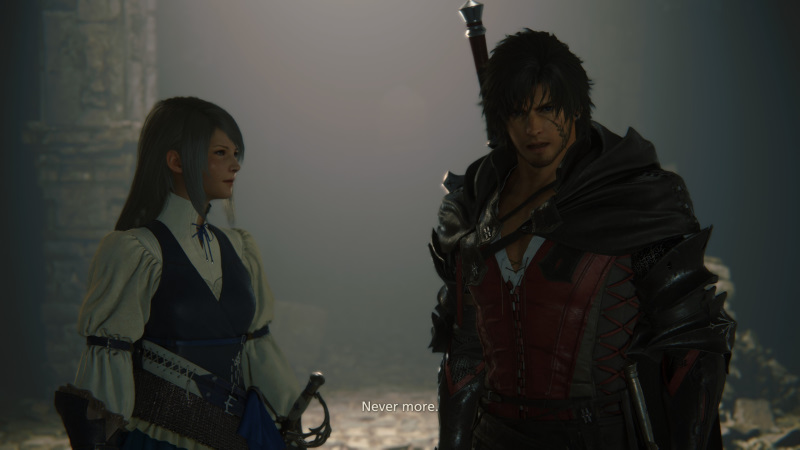
As for Clive himself, I’d consider him to be an above-average Final Fantasy protagonist. While I think he’s drier than some previous leads, he also has a proper arc which sees him grow significantly over the course of the game and I’d be lying if I said that this wasn’t satisfying at times. A few other cast members perform their roles well, Jill and Cid being two that come to mind, even if I think they pale compared to some of the greats of the franchise but I have significant issues with other characters, mainly their introductions. For a story that features so many warring states, it does a poor job of introducing the leaders and commanders. They’ll appear in an early cutscene with little to establish who they are or why they should be memorable and will then reappear many, MANY, hours later when they suddenly become relevant to the plot. A similar issue happens after a particular timeskip where a slew of characters are introduced with little to no setup. It’s actively frustrating when this happens and I truly wish that the writers had taken more care in this regard.
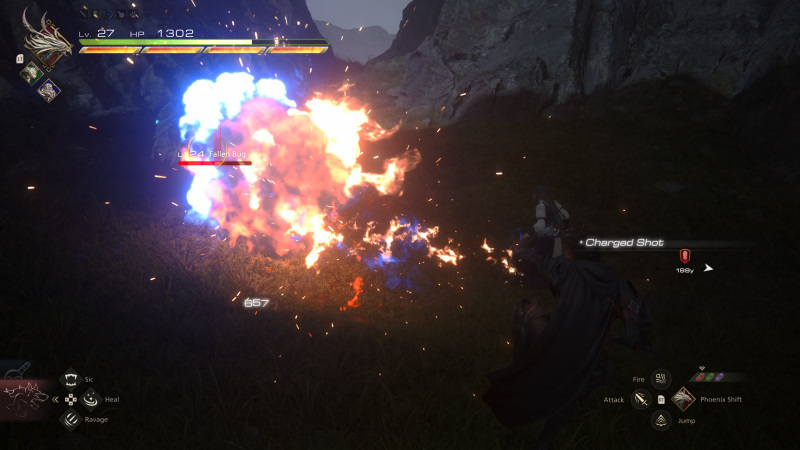
I remember Final Fantasy XVI’s combat system being highlighted as part of the marketing with emphasis on the inclusion of Ryota Suzuki as part of the team, a veteran who has worked on such series as Devil May Cry and Dragon’s Dogma. The basics of the combat system, which is explained via a lengthy and drawn out tutorial, consists of sword attacks, magic, dodging and using an Eikon ability, the default being Phoenix Shift. By dodging at the right moment, you get a brief window where you are able to do a more powerful sword strike or spell cast. You also have a few special abilities that work on cooldown and do significantly more damage than your standard attacks. When fighting bosses or minibosses, they have an additional gauge alongside their health called the Will Gauge which drains separately. The bosses/minibosses will recoil slightly once it’s been drained halfway, allowing you to get some extra attacks in, but they will completely collapse once it’s been fully depleted. During this interval, they will be left vulnerable to attacks and a multiplier will begin increasing based on the number of attacks and their strength. The initial strategy is to raise this through standard attacks and to then finish off the stagger with cooldown abilities for a large chunk of damage. However, it’s worth noting that you will eventually gain enough abilities that you can just start using them from the beginning instead.
As for how engaging this combat ultimately is, it’s a mixed bag. On one hand, bosses and minibosses can be quite satisfying to fight as you dodge through their attacks, wear down their Will Gauge and unleash your cooldowns. However, the standard enemies are quite different and, to be honest, not that fun to fight. Hardly any have, to borrow a phrase from souls-likes, poise which means that they recoil with each melee hit. Thus, you can generally button-mash your way through these fights which would be fine, somewhat, if they were simple fodder but their health pool is just enough that they feel unpleasantly spongy. Considering the number of enemies that these fights will throw at you sometimes, this can turn fights into a near mindless slog where you just slowly whittle down their numbers while repeating the same few attacks over and over.
This also moves us into the RPG elements of Final Fantasy XVI, few as they are. When Clive gains enough experience points, he levels up and gets a slew of stat increases. Separate to this are Ability Points which can be used to gain and upgrade abilities in an ability tree which is where you are able to be a little more hands on in crafting Clive’s moveset. However, this tree is very basic with no prerequisites. Clive’s core skills are relatively cheap while later investments will be in Eikon skills of which you’re likely only going to use a few. The fact that the core moveset is established so early with little to no upgrades later on contributes to the repetitiveness of combat although there are a few abilities you gain throughout the story that attempt to add some variety.
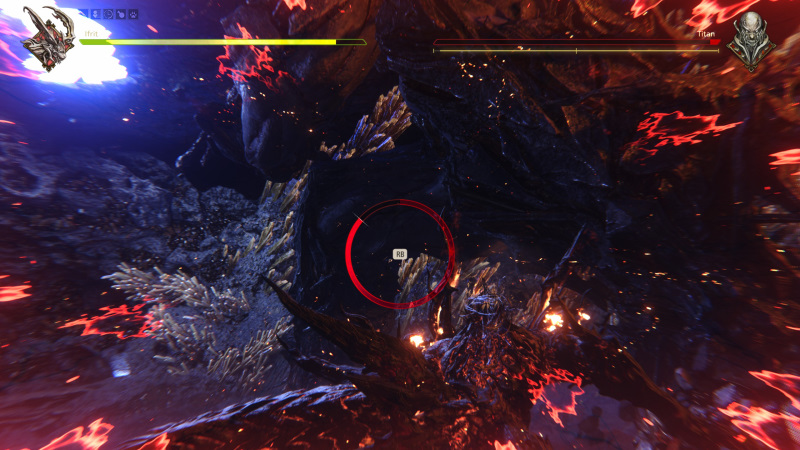
The other thing that I remember being emphasised in the marketing were the Eikon battles, big events which see massive, powerful entities face off in dramatic clashes. Ryota Suzuki even mentioned “The Eikon battles are so large-scale that 10 months to a year are allotted for the creation of just one piece of content”. While I can commend the vision and, dare I say it, ambition of this, I think it’s tragic that these battles ended up being some of my least favourite moments in Final Fantasy XVI. While the game gradually introduces new mechanics for each fight, the moveset still feels quite limited, leaving you feeling like you’re doing the same few moves over and over again. It’s also here where you’ll encounter the lionshare of the QTEs that are found in combat. They typically come under 3 types, those being, based on Xbox controls, “Press X”, “Mash X” and “Press RB”. These are very basic QTEs with a large amount of time to enter the inputs and these fail to alleviate the repetition of the fights.
Unlike in prior Final Fantasy games, Final Fantasy XVI uses a crafting system for equipment and upgrades but there’s several aspects to this that I believe take away from the experience. To start with, the crafting system is very basic. Each piece of equipment is made exclusively from materials rather than other pieces of equipment, excluding a particular line of swords, and each can only be upgraded a couple of times before requiring you to discard it for something better. It’s not great but I think the worst part is what it does to exploration. Due to this being how you acquire the vast majority of your equipment, you rarely find any while exploring save for accessories. Opening a chest and finding a bunch of crafting material isn’t as satisfying as finding a new sword or armour. It’s also worth noting that party members cannot be customised in any way so every piece of equipment you find is solely for Clive.
Speaking of exploration, let’s take a look at how Final Fantasy XVI is structured. Many of your missions will take place in one-time locations which are very linear with only a few siderooms to explore for loot. However, there are also several zones in the world that are considerably larger which you will be visiting repeatedly for the main quest, side-quests, bounty hunts etc. These zones aren’t exactly open as there are various areas blocked off until progress in the story has been made but they are quite large. However, this isn’t a good thing as navigating the world is more awkward than it should be. The developers attempted to improve navigation by providing a few fast-travel points as well as having Clive break into a run when holding the joystick for a while but movement still ends up feeling sluggish, particularly since there isn’t much to do in these zones except to run from point A to point B. I was aware that I’d have access to a Chocobo, a Final Fantasy transportation staple, at some point so I was hoping that it would mark a significant improvement in my ability to traverse the world. Imagine my shock then when I finally got the Chocobo only to find that it was only marginally faster than Clive with a far worse ability to turn. I ended up hardly ever using my Chocobo with those rare instances being where I had to run a long-distance in a straight line.
Besides progressing the main questline, these zones are quite empty with a smattering of enemies, some chests containing accessories or materials for crafting and a few towns whose services are shockingly small. There is hardly ever a reason to check out the local shop as their supplies pale compared to the equipment you can craft or the items you can find. However, these towns also serve as a source of side-quests and their general quality is rather dire. Some of these side-quests will have you running to certain spots to fight some enemies, usually a group, although just as many have you running around town to talk to a few NPCs. They are generally dull with rewards that are relatively minor. A few do contribute to world-building but these are few and far between. Bounty hunts are more interesting as you’re guaranteed to fight against a miniboss. You’re typically told in which area in the zone they are but, since they aren’t explicitly shown on the map, this is one of the few times where exploration is actively encouraged. These bounty hunts are usually a few levels above you at the time when they are first given but they are also, with a few exceptions, repeats of minibosses you’ve fought before. They can be somewhat challenging if you face them immediately but they mainly serve to test whether you’ve learned that particular boss’s moveset.
That moves us into the general difficulty of Final Fantasy XVI. Upon starting a new game, you’ll be presented with two difficulty options, “Story Focused” and “Action Focused”. Story Focused equips you with “Timely Accessories” which automate parts of the combat and also reduces the health and damage of enemies. It’s interesting to note that these Timely Accessories are also available in Action Focused although they have to be actively equipped in that mode. Even playing on Action Focused, I found Final Fantasy XVI to be an easy game with generous dodge timings and plenty of potions between battles. The only times I ever died were when I was fighting a bounty that was ten or eleven levels higher than me although, even then, I did manage to take them down in only a few tries. What’s frustrating to me is that there is a higher difficulty called “Final Fantasy Mode” which is restricted to New Game +. This involves carrying over your level, equipment, items etc. so it couldn’t necessarily work as an initial difficulty option but I do wish that, given the focus on action combat in Final Fantasy XVI, an additional higher difficulty level could’ve been included from the start.
Before I move on from gameplay to other elements, I wanted to highlight a few odd design choices in Final Fantasy XVI that stood out to me. These are pretty minor but I do have to wonder why they’re even in the game in the first place. First is that Clive, upon opening most doors or interacting with most levers, has to do a quick-time event which involves holding the right trigger. I honestly don’t know what this adds to the gameplay and comes off as annoying more than anything else. Upon completing some quests, you’re given the option to select the items to hand over. Only issue is that you are only ever given a list of items that are relevant to the quest which means you select them all anyway. Why not just have Clive hand over the relevant items? The last quirk that I want to point out is that, when you complete a notable main quest, you are sent to the world map with all options but your hideout marked off. This means that the only place you can go IS your hideout. Why not just automatically go there if that’s your only option? None of these design choices ruin the game but I do have to wonder why they were included in the first place.
As for the graphics of Final Fantasy XVI, this is an area where I think the conflict between visual fidelity and artistic direction is worth highlighting. I’ll admit that, for much of my playthrough, I kept wondering “How much have the graphics improved since Final Fantasy XIII?”, the first HD mainline entry. It wasn’t until I started looking at the finer details such as fingertips or the fabric of cloth that I was able to tell the difference so I can now confidently say that, yes, the graphics have improved since XIII. Despite that, I find myself liking the visual presentation of XIII more than XVI. XIII was rich and colourful in its art direction whereas XVI, perhaps leaning a little more into realism, comes off as more drab in comparison. Obviously, this isn’t as much of an issue whenever magic or Eikons become involved as they tend to be quite vivid in tone but these moments are distant enough that you’re often just looking at green fields, brown deserts or grey towns. The NPCs, particularly those that are side-characters or background figures, also look quite bland and generic. In contrast, main characters generally look quite a bit better and, more importantly, distinct. The animation is generally very good when it comes to battle and major cutscenes although XVI falls into the common RPG pitfall of characters standing around stiffly during minor cutscenes.
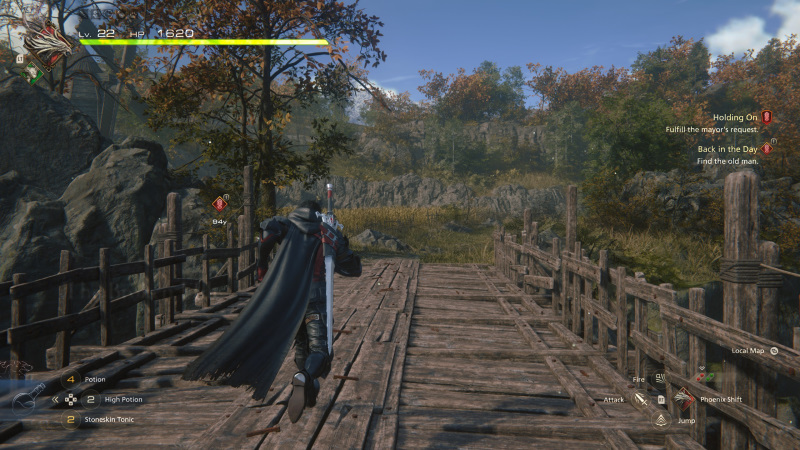
As for technical performance, it’s worth reminding that I played the PC version of Final Fantasy XVI. The requirements to run Final Fantasy XVI are very high, it’s unsupported on the Steam Deck for this reason, and it also mentions that the use of an SSD is required. My PC is very high-performance so this didn’t factor into my experience although I did run into the rare stutter. Final Fantasy XVI supports a variety of super resolution options such as DLSS 3, FSR 3 and XeSS 1.3 as well as DLSS Frame Generation and Nvidia Reflex Low Latency. A number of frame rates are also supported such as 30 FPS, 60 FPS, 144 FPS and 240 FPS although a strange choice on the developers is to lock major cutscenes to 30 FPS regardless of the FPS used in the rest of the game. I wondered at first if this might be an issue of the cutscenes being prerendered as they are clearly rendered in more detail than elsewhere. However, I eventually took notice that Clive’s sword was changing as I gave him new ones which means that the cutscenes themselves were being rendered in real-time. Given this, I have no idea why these cutscenes are locked at 30 FPS and it can often feel jarring when switching from the more fluid gameplay to the choppy cutscenes.
When it comes to audio, we’re treated to an above-par experience. The voice acting is generally pretty good although a few side-characters do sound a little off or stiff. One of the soldiers acting in the opening of the game aggravated me but I don’t recall that being such an egregious issue later on. The music was composed by Masayoshi Soken and, while I’m not familiar with his work on Final Fantasy XIV, he provides an underwhelming soundtrack compared to previous Final Fantasy games. I won’t dismiss all the tracks as I do quite like “Away” and “On the Shoulders of Giants” but the rest of the tracks failed to prove memorable and, in the case of “Our Terms” among a few others, sometimes proved irritating with its repetition and self-indulgence.
Final Fantasy XVI is an acceptable hack and slash game with some satisfying boss battles, a decent story and good graphics. However, I’ve come to expect a lot out of Final Fantasy titles, particularly mainline entries, and I find it quite sad to see what the franchise has become. Final Fantasy XVI isn’t a bad game, I wouldn’t even say it’s the worst mainline entry, but it does feel generic. For a series that has always been surprisingly willing to overhaul itself in both storytelling and gameplay systems, Final Fantasy XVI is only experimental within the context of the franchise itself. I fear that the developers might have mistaken conformity for evolution and this leaves Final Fantasy XVI with little of the identity of its predecessors. If you’re looking for a game that features a decent combat system, flashy visuals and straightforward systems then you will probably be satisfied. However, those looking for a meaty JRPG or Final Fantasy experience will likely be left wanting.

Going by the online persona Immortallium, I'm a YouTuber as well as a Manga, Anime and Video Game enthusiast.
posted by Majkol Robuschi on 25 Feb 2026
posted by Ross Locksley on 23 Feb 2026
posted by Ross Locksley on 20 Feb 2026
posted by Eoghan O'Connell on 19 Feb 2026
posted by Jared T. Hooper on 17 Feb 2026

posted by Ross Locksley on 11 Feb 2026
posted by Jared T. Hooper on 06 Feb 2026
posted by Ross Locksley on 03 Feb 2026