
Written by Richard Durrance on 08 Jan 2026
Distributor Radiance • Certificate 15 • Price £17.99
So we welcome the new year, 2026 to my reckoning, and my first review for a film released within it, Tai Kato’s 1965 Blood of Revenge courtesy of Radiance. Their releases of Kato’s work have been one of the highlights of the last couple of years, all uniformly excellent with at least one masterpiece to boot. The short book on Kato’s work, written by Tom Mes, also published by Radiance is worth your time too (I read it in the time it took to replace my boiler, the standard unit of time for all things).
1907, Osaka. Yakuza Boss, Emoto (Kanjuro Arashi), is moving away from violence and taking his construction company straight. Killed at a festival by a drifter, his wastrel son, Haruo (Masahiko Tsugawa) wants revenge against a rival company run by the ostensibly honest, Hoshino (Minoru Oki). Though kept in check by old time yakuza Kikuchi (Koji Tsurata), Haruo disappears into dissipation. So upon the old boss’s death it is Kikuchi who is named boss, and he wants to give Haruo the chance to go straight, just as his father wanted...
There’s also a lot more typical yakuza shenanigans going on than usual, to the point where the story sometimes gets a little bogged down or even slightly confusing. Hoshino seems to be introduced as if a yakuza, though apparently honest; Emoto starts off sounding like an old businessman when really he’s a yakuza playing it straight. The wayward son in Haruo is the classic "wastrel who looks to be throwing away all that the father has built" through his indolence, wine and women. The script is lacking something here that's often found in the very best of Kato’s work and honestly at times he has to drag it through the mire.
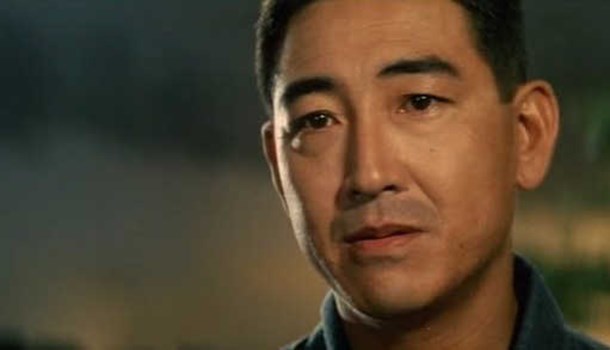
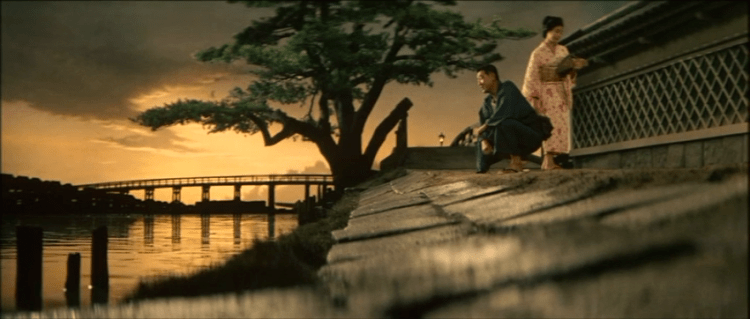
Kato’s low, low camera (sometimes so low as to make Ozu seem like the master of the crane shot) often beautifully captures images, especially the prostitute, Hatsue (Junko Fuji) waiting for, then meeting, Kikuchi. It’s gorgeous stuff with the light on the cobbles that seem to stretch on forever and the low orange sun. Time and again, Kato composes images that strike you. The opening scene is a standout; tightly framed festival preparations that suddenly explode into riotous life. Even when the story treads familiar ground, Kato brings something new and interesting for the eye.
Equally, Koji Tsurata as Kikuchi, here at the edge of his leading man era, lifts the film whenever he enters into it. He may be a bit too long in the tooth to attract the eye of Hatsue (even if he does also show her unusual generosity) but because he’s essentially the classic honourable yakuza you can see why she might fall for him. But of course he has the shoulders to carry such a role and his character does demand that he has a few years under his belt; he is very much the elder yakuza, able to suppress a temper that he may have had in his youth (we find out in passing that he has been in prison). There’s also a lovely turn by Hiromi Fujiyama as Senkichi, a travelling yakuza that talks too much and takes a shine to Kikuchi. She’s the yakuza equivalent of a hooker with a heart of gold and provides just the right level of playfulness mixed with an underlying eye for what is going on in men’s (and women’s) hearts. It’s nice to see Tetsuro Tamba is a straight role as Nomura, whose performance again gives body to some of the script's more anaemic moments.
Though parts of the script feel a bit too by-the-book, where it really starts to shine is in aspects of character development and displaying a societal shift into modernity. The setting of the film, just before the Taisho era, with its western influence and shifts in art and technology make this a story of transition. Kikuchi is the old, noble yakuza on the way out and the son of his predecessor, Haruo, is given the chance to embrace building his company while also recognising that he’ll need many of the skills of the old yakuza; courage, determination and an unflagging ability to fight back against adversity, but without a blade. Modernity comes to the fore in the story when it deals with plots and underhandedness: it’s all about building a water processing plant, providing the materials to it and, in the process, providing the materials for a future Japan and building the foundations for its success. Kikuchi and his ilk, even those apparently straight, have no real place in it.
Even the end showdown includes a steam train and takes place in part within a station. Kikuchi, at one point going relatively straight himself, is sent off to build jetties by Tetsuro Tamba’s Nomura, because this Japan will need these to support the influx of foreign and you suspect also internal trade. The final image is of a train coming right into the screen. It’s a bit of a shame that the story doesn’t make better use of the modernity theme and the ending of the ways of a generation of yakuza. It could do with cutting away some of the more rote aspects of the plotting to focus more on the shift into a new era. There is certainly enough here for the film to make its point. Kato’s direction, too, keeps the film brisk and sometimes gorgeous, the performances are also excellent, especially Tsurata - though I found myself a little irritated by Junko Fuji’s Hatsue as she’s a bit too over the top, practically wrestling with Tsurata rather than holding him. Kikuchi’s characterisation is just right for the overarching themes of the film, and beyond those already mentioned I liked the arc of Haruo’s character, which could have been woefully one dimensional.
The film never quite has the complexity of Kato’s best work, yet has moments that visually stand out thanks to his masterful direction.

Long-time anime dilettante and general lover of cinema. Obsessive re-watcher of 'stuff'. Has issues with dubs. Will go off on tangents about other things that no one else cares about but is sadly passionate about. (Also, parentheses come as standard.) Looks curiously like Jo Shishido, hamster cheeks and all.
posted by Richard Durrance on 12 Feb 2026
posted by Richard Durrance on 10 Feb 2026
posted by Richard Durrance on 07 Feb 2026
posted by Richard Durrance on 03 Feb 2026
posted by Richard Durrance on 27 Jan 2026
posted by Richard Durrance on 19 Jan 2026
posted by Richard Durrance on 17 Dec 2025
posted by Richard Durrance on 12 Dec 2025